

Previous experienceBusinesses subject to Value Added Tax
Tax Agency registration No. 30001887 — registered to act and correspond on your behalf before the FTA.
Verify on the FTA registerOpens the FTA's official register filtered to this entry (20043873).
Accounting systems that fit how you actually work
Selection, implementation, migration and clean-up of accounting systems — configured by accountants around your reporting needs rather than around a template.
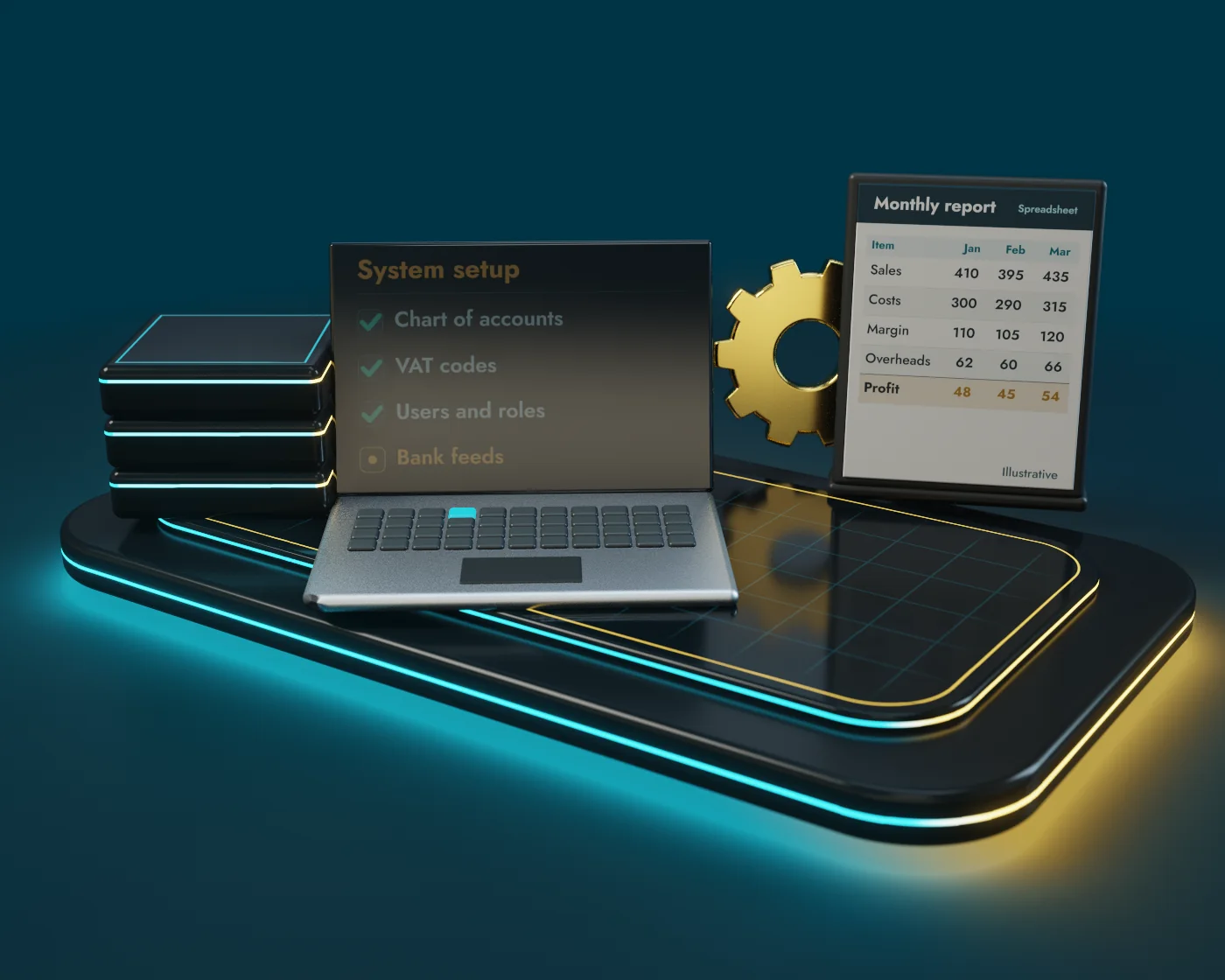
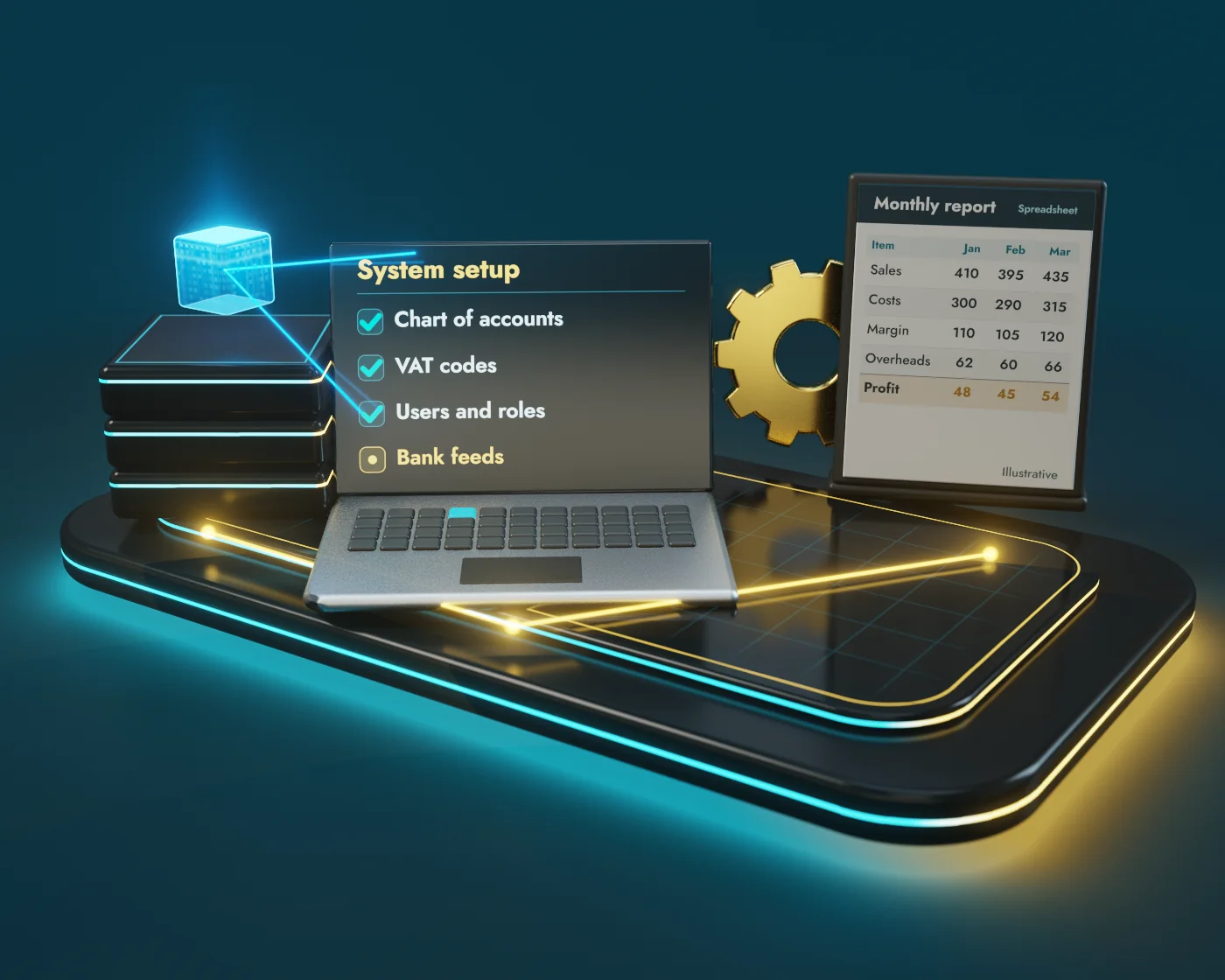
Most system problems turn out to be configuration problems
Businesses often blame the software when the real issue is how it was set up. Before recommending a change of system, it is worth establishing whether the current one was ever configured to do what you actually need.
The software gets the blame
- Every report needs manual rework in a spreadsheet before anyone can use it.
- The chart of accounts has grown organically and no longer mirrors the business.
- A previous implementation was started but never finished properly.
- Several entities run on several systems, and consolidation happens by hand.
Tracking categories nobody maintains and tax codes nobody checked are the usual root causes.
Accountants who configure the system around your reporting
- An independent assessment: reconfigure what you have, or move — and why.
- Chart of accounts, tax codes, tracking categories and opening balances done properly.
- Migration with reconciliation back to the old system, so nothing is lost or distorted.
- Reports built inside the system, and a team trained to run them every month.
Configured by accountants, not sold by a reseller. See the systems we work with
From the source system to the report
Six systems UAE businesses actually run
We are accountants who configure systems — not resellers. We work inside the software you already use or are choosing. The recommendation follows your requirement — size, volume, activity and the reports you need — not a vendor relationship.
Four engagements, one standard
Every engagement is scoped in writing before work begins. Each card shows when an engagement applies, what it includes and what you are left with; the table shows which components each one carries.
You receive the closed books, the pack and the reviewer's sign-off — every period, in writing.
| Engagement | New implementation | Migration | Clean-up & re-structure | Training & handover |
|---|---|---|---|---|
| Chart of accounts designStructured around your reporting | Included | On request | Included | Not included |
| Tax codes & VAT setupRates, treatments and reverse-charge configured | Included | Included | Included | Not included |
| Opening balances & reconciliationBalances that tie before go-live | Included | Included | On request | Not included |
| Report configurationManagement reports built inside the system | Included | On request | Included | On request |
| User roles & permissionsApproval flows that support your controls | Included | On request | Included | Included |
| Team trainingPractical, role-based, on your own data | Included | On request | On request | Included |
| Reconfiguring an existing system is often the less costly answer. We tell you which engagement applies — in writing — before any work is quoted. | ||||
Amber = available on request within the engagement. Nothing here is a price list; scope first, then a written quote.

The month-end, walked through together
Your reports are read with you, not sent to you. The person who prepared the numbers explains what moved and why, and what to decide before the next close.
Five steps from first review to a close you run yourself
The same sequence whether we are implementing, migrating or cleaning up — only the depth of each step changes.
We reconfigure when
- The ledger is sound but modules are unmapped or unused
- VAT codes and the chart of accounts need correcting, not replacing
- Reports are rebuilt by hand because the system was never set up to produce them
- Approvals and bank feeds exist but were never switched on
We recommend moving when
- The system cannot hold the entities, currencies or volume you now run
- E-invoicing data fields cannot be captured or exported
- Bank feeds and an audit trail are unavailable
- Vendor support or updates have ended
A system set up today should not need redoing tomorrow
Structured, correctly coded data is what UAE e-invoicing will draw on. We configure with that in mind — and we are clear about what exists today and what is only a direction.
Structured invoicing data
Customer TRNs, tax codes, line-level data and document numbering configured correctly inside your system, so every invoice already carries the fields structured invoicing relies on.
Delivered inside the software you already use — part of every implementation and clean-up.UAE E-Invoicing readiness
A structured review of how you invoice today — systems, invoice data, tax setup — and a prioritised plan to close the gaps before the framework requires it.
Delivered as professional advisory. AL TAMAYUZ is not an accredited service provider.Connected business operations
Books, invoices and reporting moving as one flow — with accredited providers where the UAE framework requires them — is the direction we are building toward.
Direction, not an offer. Dates only from official announcements.What your system has to get right
Two factual summaries from the Knowledge Hub that shape how an accounting system should be configured in the UAE.
UAE VAT record-keeping — what your system must retain
Registered businesses must keep the records, tax invoices and returns that support their VAT position — the reason tax codes and invoice data must be configured correctly from the start.
UAE E-Invoicing — invoices as structured data
The UAE is introducing structured electronic invoicing for business transactions — invoices as standardised digital data exchanged through accredited channels rather than PDFs.
Questions we are asked before every implementation
That depends on your size, transaction volume, industry and reporting needs — there is no single right answer. We work with the systems commonly used by UAE businesses and are not tied to any vendor, so the recommendation follows the requirement. In the first review we set out which options fit, and why, in writing.
Very often, yes — and it is usually the less costly answer. Reconfiguring the chart of accounts, tax codes and reports resolves a large share of the complaints we hear about accounting software. We start with a diagnostic of the current setup and only recommend a move when the system genuinely cannot do what you need.
We agree how much history to bring across — full detail, opening balances plus comparatives, or a defined window — and document a cut-over date. The data is mapped and migrated, then the migrated balances are reconciled back to the old system, so nothing is lost or distorted.
That is part of the work, not an afterthought. An implementation the team cannot operate confidently drifts back to spreadsheets within months, and then you have paid for both. Training is role-based and run on your own data, and we stay through the first reporting cycles until the close runs without us.
The system should fit the business — reconfigure or move, but decide on evidence.
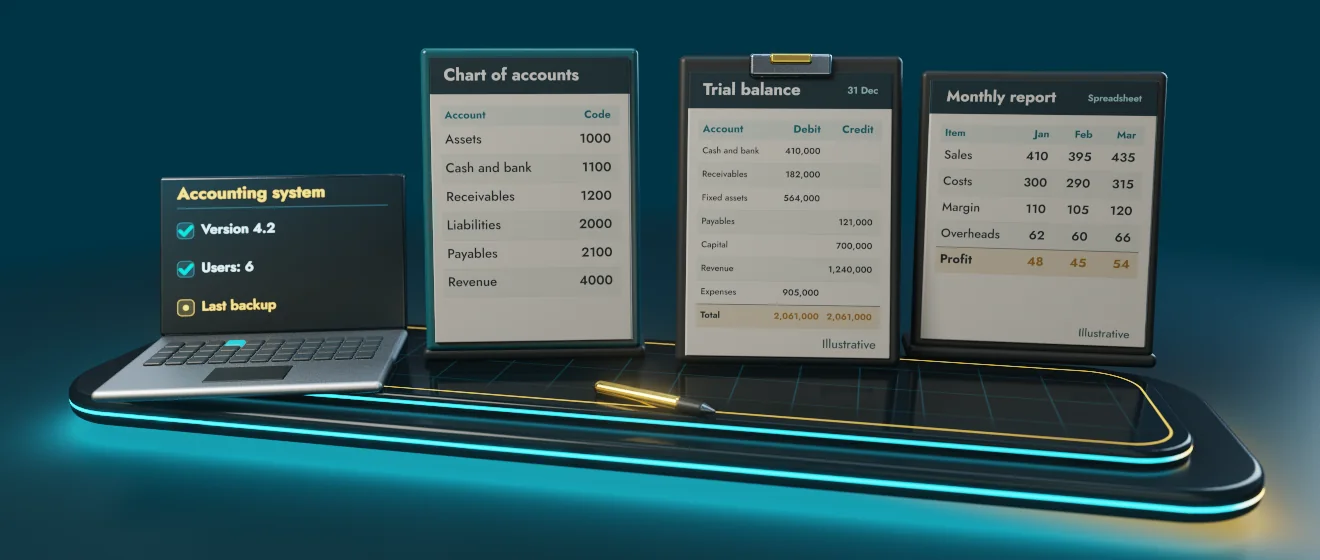
Make your accounting system work properly
Tell us which system you run today and what you rebuild by hand each month. A specialist reviews it and comes back with a clear recommendation — reconfigure or move — and a written scope before any work.
 1234
1234Discuss my accounting system
A systems specialist responds promptly.
A written quote before any work. We use your details only to respond to your request.
We reply
A prompt reply, with the questions we need answered about your current setup.
First stepSystems review
A short call to look at your chart of accounts, reports and pain points — online or at our office.
At your convenienceRecommendation and scope
Reconfigure or move, with a written scope and quote before any work begins.
Before any workMake your accounting system work properly
Book a consultation and get a clear recommendation — reconfigure or move — before any work is quoted.