

Previous experienceBusinesses subject to Value Added Tax
Tax Agency registration No. 30001887 — registered to act and correspond on your behalf before the FTA.
Verify on the FTA registerOpens the FTA's official register filtered to this entry (20043873).
Financial reporting that management can actually use
Periodic financial statements and reporting packs prepared to a consistent, IFRS-aligned standard — accurate, on time, and explained in terms that support real decisions.


Reports people can act on
Many businesses receive figures that arrive weeks late, change between versions, or present numbers with no explanation attached. That turns reporting into a compliance chore rather than a management tool.
Good reporting closes on a predictable schedule, applies consistent treatment period to period, and tells you plainly what changed and why. That is the standard we build with you — and hold to every period.
- Your figures arrive too late in the month to act onBy the time the pack lands, the decision it should inform has already been taken
- The numbers change between versions and confidence has erodedReclassifications and late entries with no explanation of what moved
- You need a reporting pack for a bank, an investor or a parent companyIn their format, on their timetable, with schedules that stand up to questions
- You are growing across several entities and need consolidated reportingIntercompany balances, eliminations and one group view
- You have plenty of data but no interpretation of what it meansReports without commentary leave the reading to you
Three statements, one story
Three statements, each answering one question — and each one feeding the next.
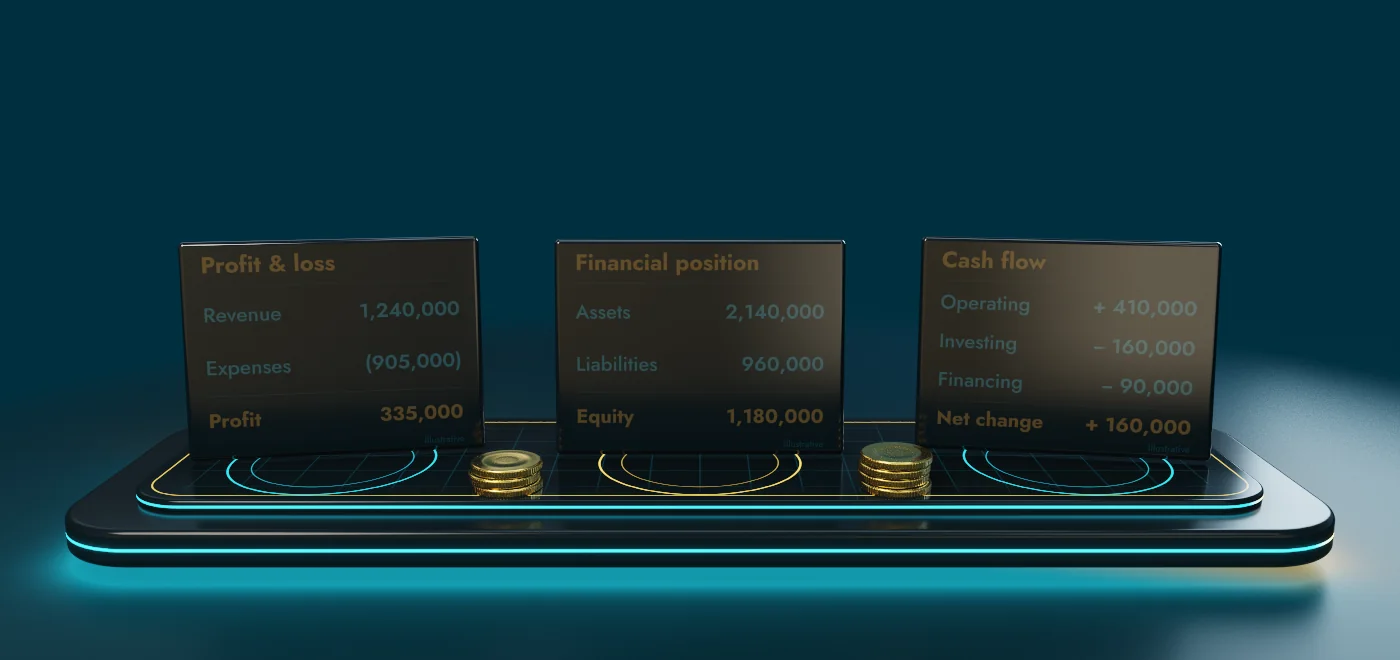
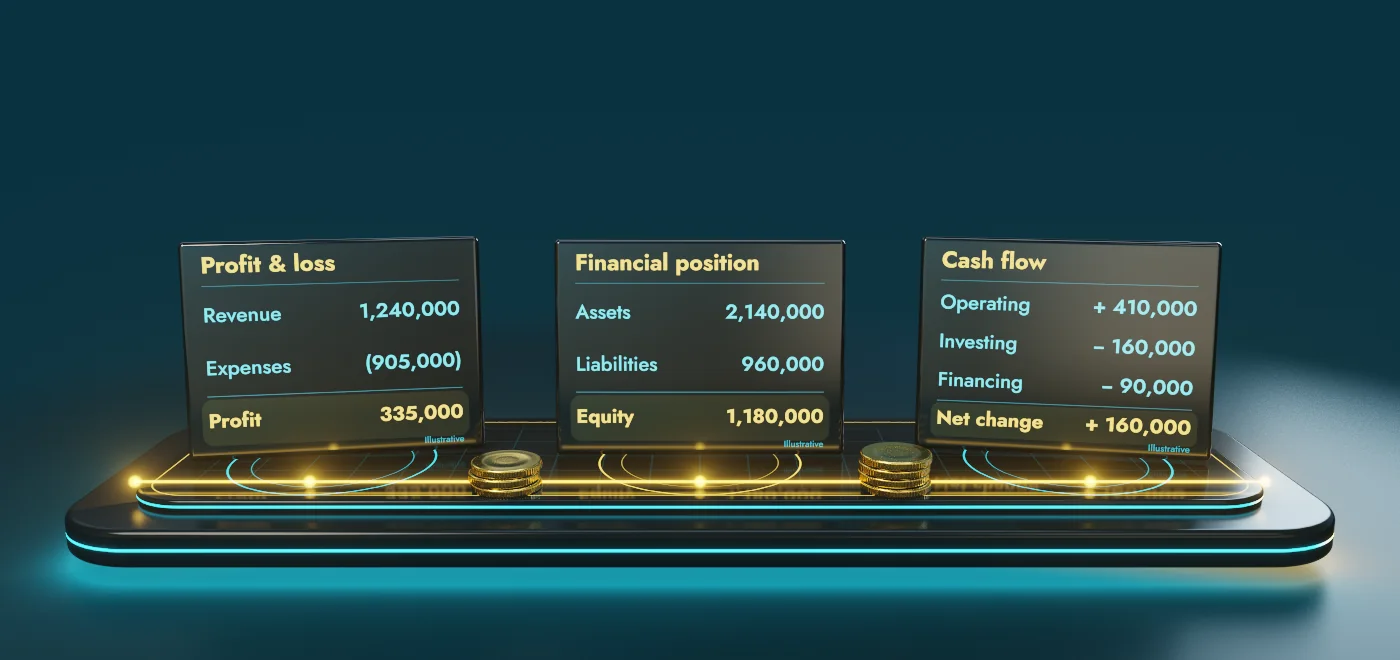
Profit & loss
What was earned this period
Statement of financial position
What the business owns and owes
Cash flow statement
Where the cash came from and went
Three report layers, one consistent basis
Every layer is prepared from the same records, on the same IFRS-aligned basis, and reviewed by a senior before it leaves us. The difference is who reads it, how often, and how much support sits behind it.
| Layer | Monthly management pack | Annual financial statements | Audit-ready / lender pack |
|---|---|---|---|
| FrequencyHow often it is produced | Monthly or quarterly, on a fixed close calendar | Once a year, after the year-end close | When a bank, investor or parent company asks — or annually alongside the audit |
| AudienceWho it is written for | Owners and management | Shareholders, auditors and the tax authority | Lenders, investors, a parent company and external auditors |
| What's insideThe core contents | Income statement, balance sheet, cash flow, agreed KPIs and variance commentary | Statement of financial position, profit or loss, cash flows, changes in equity and the notes — on an IFRS-aligned basis | The annual statements plus supporting schedules, reconciliations and the working papers an auditor or lender expects |
| Review levelWho reviews it | Prepared by a specialist, reviewed by a senior before release | Senior review of every statement and note; the basis is confirmed with you at the outset | Senior review plus a pre-audit pass against the auditor's or lender's request list |
| Built forThe decision it supports | Steering the business month to month | Statutory records and the Corporate Tax return | Financing, due diligence and group consolidation |
| Scope first, then a written quote. Any layer can be combined with consolidation across entities and branches. | |||
Nothing here is a price list — each engagement is scoped in writing before any work begins.
Six things we prepare — and explain
The reporting set is built around the decisions you actually make, then produced to the same standard every period.
You receive the closed books, the pack and the reviewer's sign-off — every period, in writing.
Where the cash came from and where it went



 Cash19%Receivables26%Inventory15%Fixed assets40%Payables22%Borrowings28%Equity50%AssetsLiabilities & equity
Both sides always balance — the statement shows what the business owns and how it is financed.

The month-end, walked through together
Your reports are read with you, not sent to you. The person who prepared the numbers explains what moved and why, and what to decide before the next close.
A reporting cycle that closes on time
Five steps on one fixed calendar. The date is agreed with you at the outset, and every period is reported against it.
Built for businesses that report to someone
Owner-managed businesses, growing SMEs, groups, and companies reporting to lenders, investors or an overseas parent — anyone who needs reporting to a dependable standard and schedule.
Owner-managed businesses and growing SMEs
You run the business from the numbers and need them early, consistent and explained. A monthly pack you can read in twenty minutes replaces the spreadsheet that never quite reconciles.
Groups with several entities or branches
Each entity closes on its own; the group needs one view. We reconcile intercompany balances, apply eliminations and produce consolidated statements and a group pack on the same calendar.
Companies reporting to lenders, investors or a parent
A bank covenant, an investor update or a parent-company template comes with its own format and timetable. We build the pack to their requirements and keep it consistent with your statutory statements.
The rules your reporting sits under
Two official references that shape how UAE financial statements are prepared and used. Summaries explain; the official text is authoritative.
Financial statements and the Corporate Tax return
Taxable income starts from the accounting income in your financial statements. Consistent, IFRS-aligned reporting is therefore the groundwork for the return, not an afterthought to it.
Who must prepare audited financial statements
Certain taxable persons must prepare audited financial statements for Corporate Tax purposes — we confirm whether the requirement applies to you. Audit-ready reporting makes that a routine, not a project.
Frequently asked questions
On the basis appropriate to your entity and its reporting requirements, aligned to IFRS and confirmed with you in writing at the outset. Where a lender, an authority or a parent company requires a specific framework, we align to it — and apply it consistently period to period.
That depends on how quickly source data — bank statements, sales and purchase records, payroll — reaches us. A defined close calendar means the date is known and stable. We agree a target at the outset, publish the cut-off dates your team must meet, and report against it every period.
Yes, and often that is the best arrangement. We set the structure — chart of accounts, close calendar and pack format — prepare the technical elements such as accruals, consolidation and the notes, and review the output before issue. Your team keeps day-to-day processing; the pack leaves with one set of numbers.
Yes. Bookkeeping produces the underlying records — transactions posted, coded and reconciled. Financial reporting turns those records into statements and a management pack, adding the analysis and explanation a decision-maker needs. If your books also need attention, our Accounting & Bookkeeping team can take that on.
Statements the board can read, issued on the same cadence every period.
Let us build reporting you can rely on
Tell us what your reporting needs to answer, and for whom. After a short consultation you receive a written scope and quote — before any work begins — and a first close date you can plan around.
We reply
A prompt reply, with the questions we need answered.
First stepShort consultation
Online or at our Business Bay office, at your convenience.
At your convenienceScope and quote
A written scope, quote and first close date before any work begins.
Before any work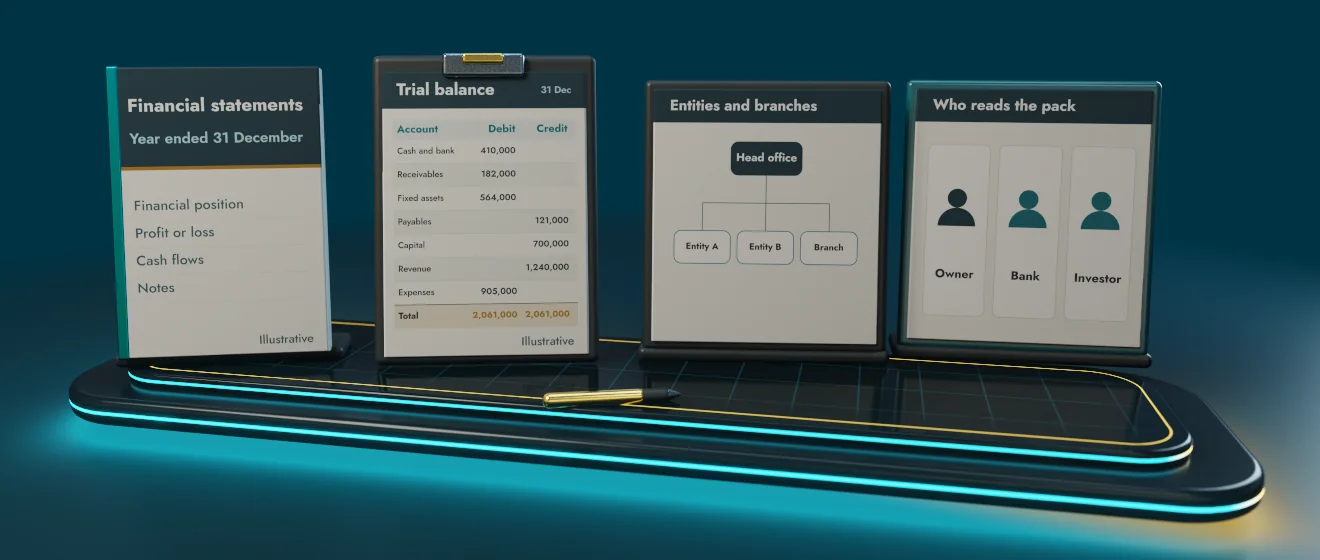 1234
1234Improve my financial reporting
A specialist responds promptly.
We use your details only to respond to your request.
Reporting connects to everything else we do
Reporting you can rely on — from the next close
Book a consultation and get a clear next step promptly — then a written scope, a quote and a first close date you can plan around.